
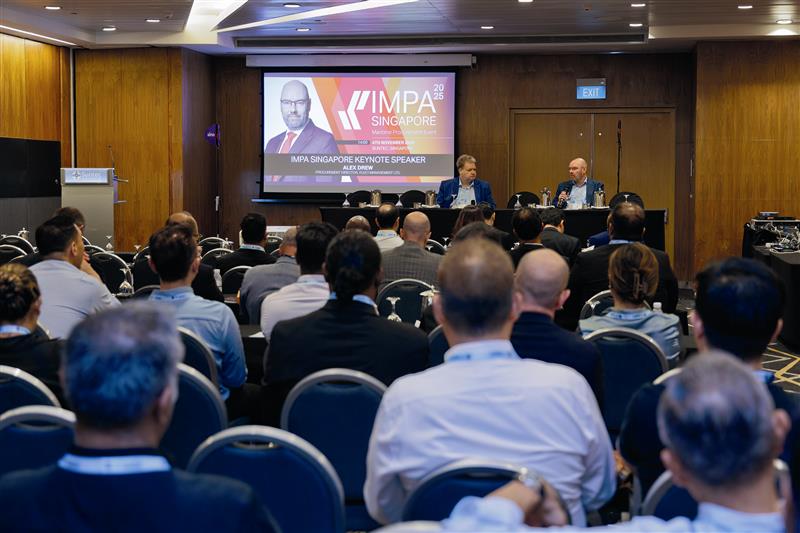

At IMPA Singapore 2025 on 4th November, the keynote interview turned the spotlight firmly onto the recently-formed Global Maritime Procurement Council (GMPC) and its plans to reshape how the industry thinks about talent, digitisation and collaboration. In conversation with Marcus Hand, Editor of Seatrade Maritime News, Alex Drew, Procurement Director at Fleet Management Ltd and leader of the GMPC’s Talent Development workstream, unpacked what the Council hopes to deliver – not just for its members, but for the entire maritime supply chain.
Formed by some of the world’s leading shipowners and managers and already representing more than 4,000 vessels, the GMPC exists to deliver value for the maritime supply chain, Alex stressed: “If we won’t be able to point regularly to tangible improvements, then we will have failed.” The intent is not another “talking shop” or PR vehicle, but a council focused on practical outputs that can be adopted, adapted and used by the wider industry.
From big ideas to focused workstreams
Coming out of the Council’s first in-person meeting in London, members quickly agreed that trying to tackle everything at once would be a mistake. Instead, they chose to start with just two workstreams – the areas that “almost unanimously captured everyone’s imagination and passion”:
• Digitalisation – led by Paolo Magonio, Group Procurement Manager at Scorpio Group;
• Talent Management – led by Alex Drew, Director of Procurement at Fleet Management Ltd.
While AI inevitably features in discussions, Alex was clear that the focus is much broader: creating digital standards and ways of working that make life easier for both buyers and suppliers, rather than building “ten different digital standards” that vendors must struggle to support.
On the talent side, the workstream is driven by a very personal motivation. Alex started his own career as an
entry-level buyer and remembers a distinct lack of guidance around career development. Today, he wants new entrants to maritime procurement to enjoy a clearer path.
Building a common career ladder for maritime procurement
A major strand of the Talent Development workstream is the creation of a shared “career ladder” for maritime procurement. Alex visualizes this as a structured view of roles, responsibilities and progression. The workstream
plans to collaborate with external partners, such as recruitment specialists, to map out:
• The range of roles that exist in maritime procurement,
• How those roles compare with non-maritime procurement functions,
• Potential career paths (vertical and lateral) between those roles,
• The education and training needed at each stage.
IMPA Education’s training programmes are expected to play an important role, with future programmes being increasingly shaped by the GMPC and its Talent Management workstream. Rather than relying on broad, comprehensive courses, the direction is moving toward modular learning; that is, targeted, flexible study blocks
that allow professionals to build the specific skills they need, when they need them. The overarching aim of this workstream is that new professionals coming into the industry can share a common baseline of competence, understanding and skill- and knowledge-building. Over time, the workstream hopes to develop templates for job descriptions, career frameworks and education pathways that can be freely adapted by any organisation, whether or not they sit around the GMPC table.
The intent is not another “talking shop” or PR vehicle, but a council focused on practical outputs that can be adopted, adapted and used by the wider industry.
Why the GMPC matters beyond Its membership
Alex emphasised that the Council is not chasing membership numbers for their own sake. There are no membership fees, and commercial topics are strictly off limits. Instead, the focus is on operational and strategic capabilities: how organisations structure procurement, how they work with suppliers, how they leverage digital tools and how they develop people.
The deliverables the GMPC hopes to produce, e.g. digital standards, shared frameworks and practical templates, will be made available to the wider market. For a company going through a growth phase or trying to specialise its procurement function, being able to pick up a standard career framework or a ready-made role profile “as a starting point” could save significant time and effort.
“You don’t have to be interested in the GMPC,” Alex suggested, “but you might still benefit from what it produces.”
Talent, ethics and the reality of retention
During the Q&A, the discussion soon moved to a familiar pressure point: finding and keeping good people. With buyers and category managers in such high demand, one attendee asked whether GMPC members should agree not to hire talent away from one another.
Alex was candid that the topic had not even surfaced within the Council, and that people will always move between organisations and across the industry. Instead of focusing on informal agreements about hiring, he argued, companies should focus on becoming employers of choice. Salary and benefits matter, but so does the chance to be part of genuine transformation.
For many people outside the sector, maritime procurement does not immediately sound as glamorous as, say, banking or consulting. Yet Alex sees that as an opportunity: because the industry still has so much room to modernise and improve, ambitious people can play a more visible role in changing things than in more mature sectors.
Bridging sea and shore
Another audience challenge came from the vessel side: is today’s procurement workforce missing crucial real-world understanding of ships and operations? Should everyone in purchasing have seagoing experience?
Alex acknowledged the importance of seafarer insight, but argued against a one-size-fits-all requirement. At Fleet Management, new buyers are encouraged to visit vessels in port and spend time alongside technical superintendents – many of whom do have seafaring backgrounds. For some roles, especially technical category management, ex-seafarers bring an invaluable depth of knowledge.
However, Alex cautioned against insisting that every buyer must have sailed. What matters more, he suggested, is blending perspectives: operational experience from sea, procurement expertise from shore, and an appreciation of the pressures faced by stakeholders onboard, particularly when delays or failures hit critical supplies.
The focus is on operational and strategic capabilities: how organisations structure procurement, how they work with suppliers, how they leverage digital tools and how they develop people.
Digitalisation and an “Amazon for Ships”
A recurring theme throughout the session was the need to relieve buyers and suppliers from low-value, repetitive tasks. One audience member pointed out how demoralising it can be to chase three (or more) quotes for every low-value line item, day after day, when digital tools could and should be doing much of the heavy lifting.
Here the link between the digitalisation and talent workstreams was clear: use technology to remove unnecessary friction and free people to focus on higher-value activities.
This ambition fed into a lively discussion about catalogues and consumables. As multiple participants noted, items that represent only a few percentage points of OPEX can consume half of all transactional effort. Alex described his “utopia” as something akin to “Amazon for ships”, where low-strategic, routine items simply flow through the system with minimal intervention.
Rather than building a single industry catalogue, Alex argued, companies should at least be able to standardise their own internal catalogues; for example, settling once and for all on a single screwdriver spec instead of supporting a “rainbow collection” of SKUs. GMPC’s role, he suggested, is to help define data and communication standards that make it easier for suppliers to share catalogues in consistent formats, potentially enriched with sustainability metrics drawn from initiatives such as IMEF.
GMPC’s role is to help define data and communication standards that make it easier for suppliers to share catalogues in consistent formats, potentially enriched with sustainability metrics drawn from initiatives such as IMEF.
Looking ahead: Deliverables first, new workstreams next
When asked how the GMPC would judge its success in its first year, Alex was succinct: “Deliver on our two workstreams.”
If the Council can point to clear, tangible outputs, e.g. a digitalisation standard, a recognisable career framework, shared job profiles and education pathways, then, he believes, it will have earned the right to expand into new areas. If, on the other hand, nothing concrete emerges, then the GMPC will have failed to justify its existence. Looking beyond 12 months, Alex sees no shortage of potential new workstreams. AI is an obvious candidate: widely discussed, frequently piloted, yet still far from delivering its full transformational potential in maritime procurement. More broadly, he doubts anyone in the sector could honestly claim to have reached the “utopia” where nothing more needs improving.
A personal journey into maritime
Fittingly for a session centred on talent, the interview closed with a more personal question: why did Alex, a procurement professional of more than 20 years, choose to join maritime only three years ago? His answer underscored many of the themes running through the conversation. Maritime itself was not the original draw. Instead, he was attracted by the sheer volume of opportunity – “the chance to make a visible difference in an industry ripe for change”. What he found after joining, Alex said, was a sector full of passionate people and an energy that quickly becomes infectious. “Today, that same sense of opportunity and passion is what underpins the
GMPC and its workstreams.”
GMPC: The latest developments in brief
Full updates coming in the next issue.
Across both the Digitalisation and Talent Management workstreams, the GMPC has begun laying the foundations for a busy year of work ahead. Recent focused meetings of the Digitalisation workstream saw members align on the creation of a minimum digital benchmark for procurement, as well as set plans for the launch of an industry-wide digitalisation survey supported by external experts. On the Talent Management side, members have started shaping the first maritime procurement skills framework, establishing clearer career paths and exploring modular, assessment-led training. This work will directly influence how future IMPA Education programmes are designed, moving away from all-in-one courses and more toward flexible modules shaped by GMPC’s guidance, ensuring professionals are trained on the right skills at the right time. An industry-wide talent survey is also being prepared for early 2026.
Shape the future: Join the GMPC
“Interest continues to build, with more companies expected to join in the coming weeks. As GMPC’s work gathers pace heading into 2026, this is the perfect moment for new voices and fresh ideas”, said Paolo Magonio, Chairman of the Council. If you are ready to help drive change, challenge industry norms, and take part in building stronger, smarter procurement frameworks, this is your invitation. Reach out to Stephen Alexander (salexander@impa.net) or Paolo Magonio (pmagonio@scorpiogroup.net) to express your interest in joining the GMPC.